Sesamers works with major European trade shows to bring startups, investors and ecosystem partners into their programmes.
I joined to work on marketing and partnerships, starting with European ecosystem outreach around SXSW. As the event campaigns picked up, more of my work moved into commercial development.
Every show had its own market. For each one I had to work out which companies would get real commercial value from being there and find a reason to approach them that held up. Then I took the strongest from a cold list to a conversation and, where it made sense, to a signed package. The pipeline I built contributed to 17 packages. I closed three of them myself, worth €13,900: a €7,900 stand at Vitafoods Europe and two €3,000 Startup Village packages at JEC World.
01Market mapping and target definition
Commercial fit mattered more than meeting startup screening criteria.
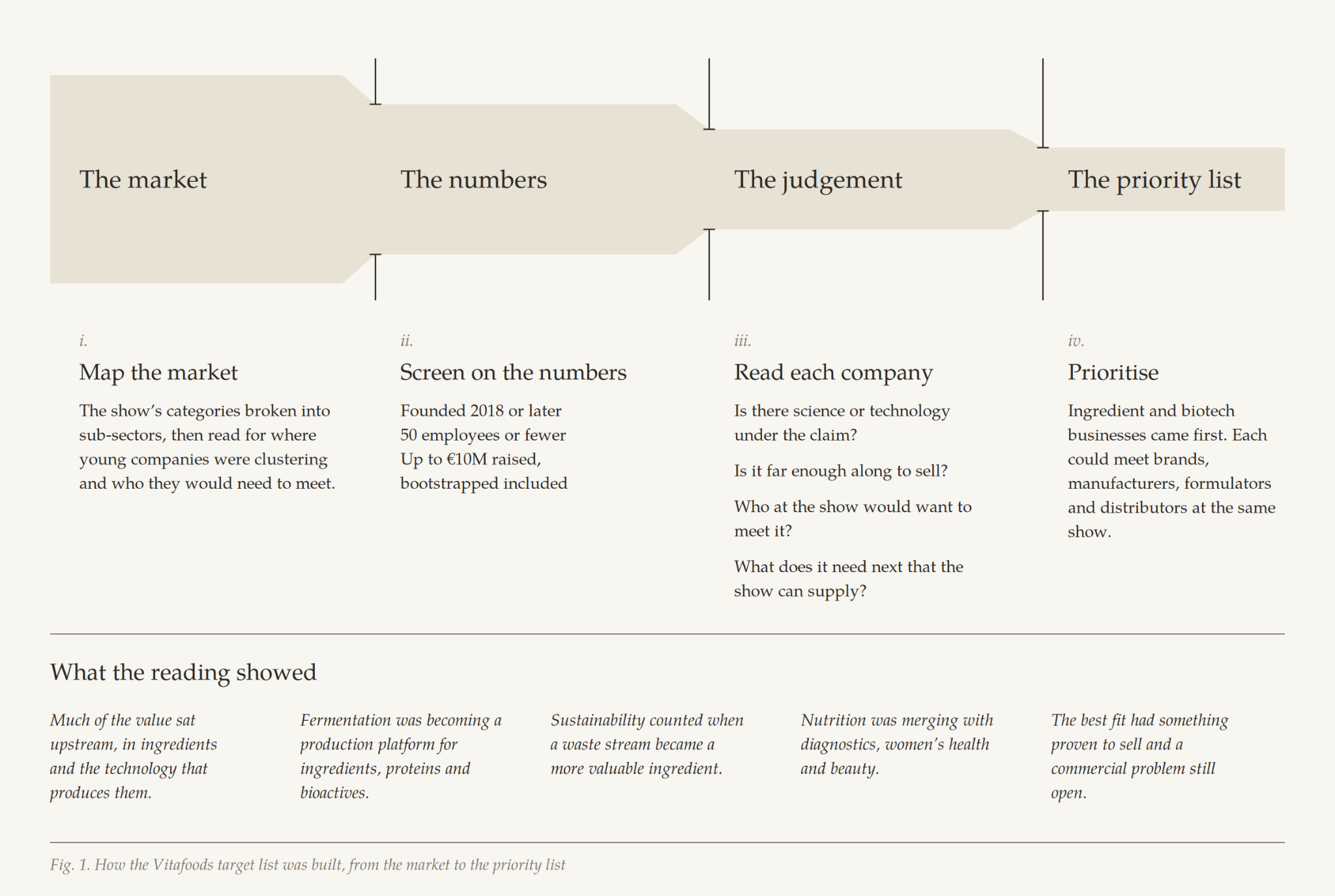
My first large outbound project was Vitafoods Europe, the nutraceuticals trade show in Barcelona. Plenty of companies sit somewhere in health and nutrition. I was looking for young ones far enough along to get something commercial out of exhibiting, and I needed to understand who they would want to meet once they were there.
I split the market into sub-sectors and screened companies with a simple filter: founded in 2018 or later, 50 employees or fewer, and up to roughly €10 million raised, bootstrapped businesses included. That gave me a workable universe. Reading each company decided who stayed on the list. I looked at what the product was and how mature it was, who would buy it or partner with it, and what Vitafoods could realistically do for it. Ingredient and biotech companies stood out, because one show could put them in front of brands, manufacturers, formulators and distributors at the same time.
The reading also changed how I saw the category. A lot of the interesting activity was upstream, in ingredients and the technology used to make them. Fermentation was turning into a production platform for proteins and bioactives. Companies were treating waste streams as raw material, and nutrition was moving closer to diagnostics, women's health and beauty. The final priority list had around 150 Spanish startups, chosen with those shifts in mind.
 View larger
02Prospect database and segmentation
Sector segmentation turned fragmented records into actionable commercial targets.
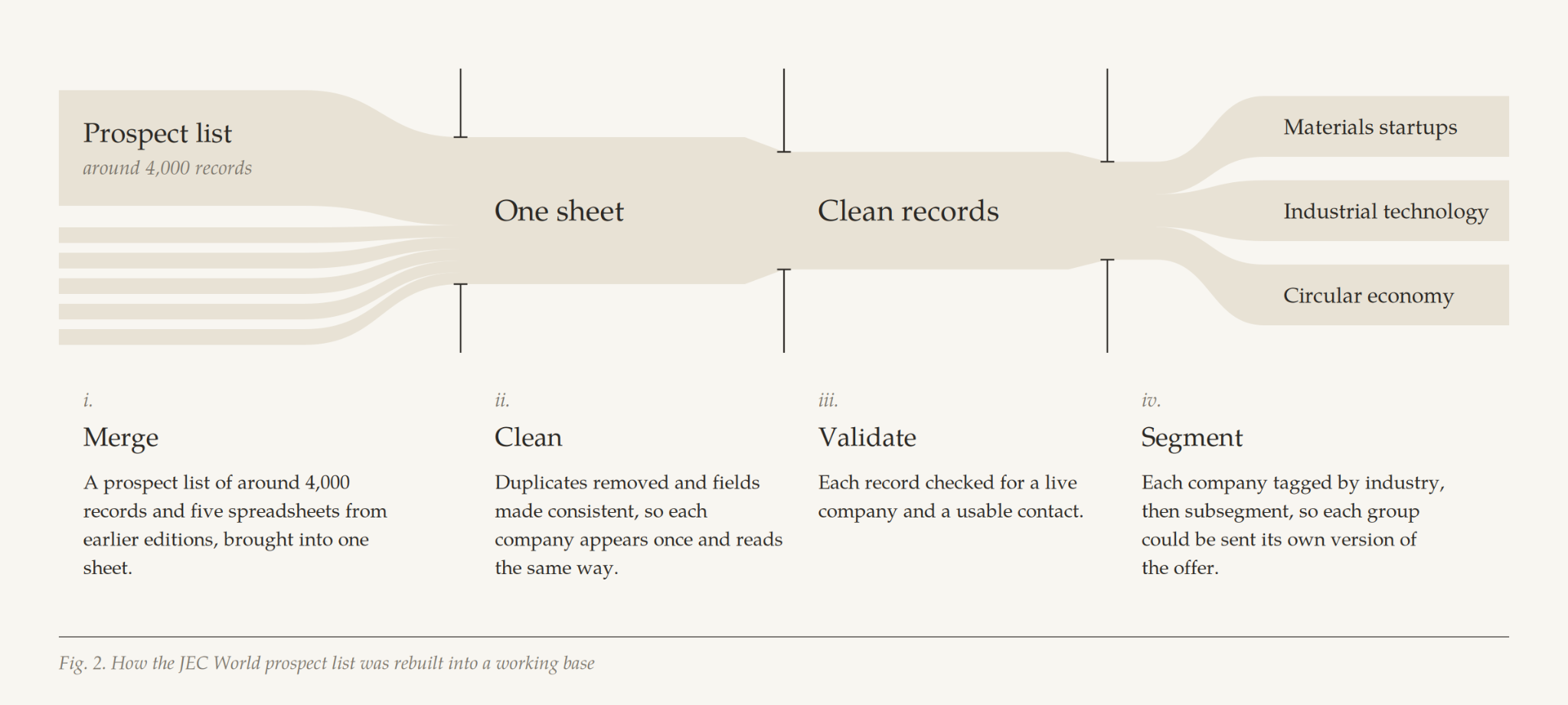
At JEC World the prospects already existed. They sat in a 4,000-record list and five spreadsheets built up over previous editions, and in that form they were hard to use.
I merged the files, cleaned and checked the data, and rebuilt the list by industry and sub-sector. A materials startup, an industrial technology company and a circular-economy business could all belong at JEC, each for a different reason. Once the database was organised around those differences, the outreach could speak to the reason that applied. The team ended up with a working database with clear groups and priorities for each campaign.
 View larger
03Outbound messaging and sales enablement
Approximately 40% replied to tailored outreach, including declines.
For Vitafoods I wrote to prospects in Spanish and adjusted the commercial angle to each business. A consumer supplement brand would likely care about distribution. An ingredient startup would care more about reaching formulators and manufacturers, and a technology company about partnerships or access to brands. Around 40 percent of the list replied, declines included, and I kept adjusting the messages as the replies came in.
At JEC I built sector-specific templates and follow-up sequences that the rest of the team could adapt for their own campaigns. I also wrote a guide for external collaborators on who to target, how to frame the offer, how much to personalise, how to structure the first message and when to follow up.
Commercial rationale by company type
Consumer brand
Distribution
A consumer supplement brand would likely care about distribution.
Ingredient startup
Formulators & manufacturers
An ingredient startup would care more about reaching formulators and manufacturers.
Technology company
Partnerships & brand access
A technology company would care about partnerships or access to brands.
04Partnership development and pipeline management
Qualification protected senior time and kept viable opportunities moving.
I stayed with prospects after the first reply. That meant follow-ups, LinkedIn conversations, practical questions, booking meetings and deciding when someone was ready to go to a senior colleague.
Sending every interested reply straight to a meeting would have used up senior time, and leaving a serious prospect in email too long could lose them. Before a call I tried to settle the basics: what the company wanted from the show, whether the package fit its budget, whether it had a real commercial reason to be there, and what Stéphane or another senior colleague would still need to answer.
For Vitafoods I took prospects from research through outreach, calls and follow-up. For JEC I handled conversations around Startup Village and Investor Day, timed the follow-ups and kept opportunities moving from first interest to a decision.
05Conversion and commercial ownership
Personally closed three packages worth €13,900.
At Vitafoods I closed a €7,900 stand with a company from the list I had built and contacted myself. At JEC World I closed two €3,000 Startup Village packages from the rebuilt database. In each case I had mapped the market or cleaned the list, written the message, made first contact and handled the follow-up before the deal closed.
Of the 17 packages my pipeline contributed to, 14 were JEC World Startup Village packages at €3,000 each. Together with the Vitafoods stand, those fifteen came to €49,900.
I had started close to marketing and ecosystem partnerships. By the end most of my work was commercial, and other people on the team were using the templates and guides I had built.
| My direct closes | Packages | Value |
|---|---|---|
| Vitafoods Europe | 1 | €7,900 |
| JEC World · Startup Village | 2 | €6,000 |
| Total | 3 | €13,900 |
06After Sesamers
Sesamers proposed renewed collaboration with greater commercial ownership.
After the internship ended, Sesamers came back to me in September 2026 about fractional commercial work. This time I would own a new project focused on software and hardware startups.