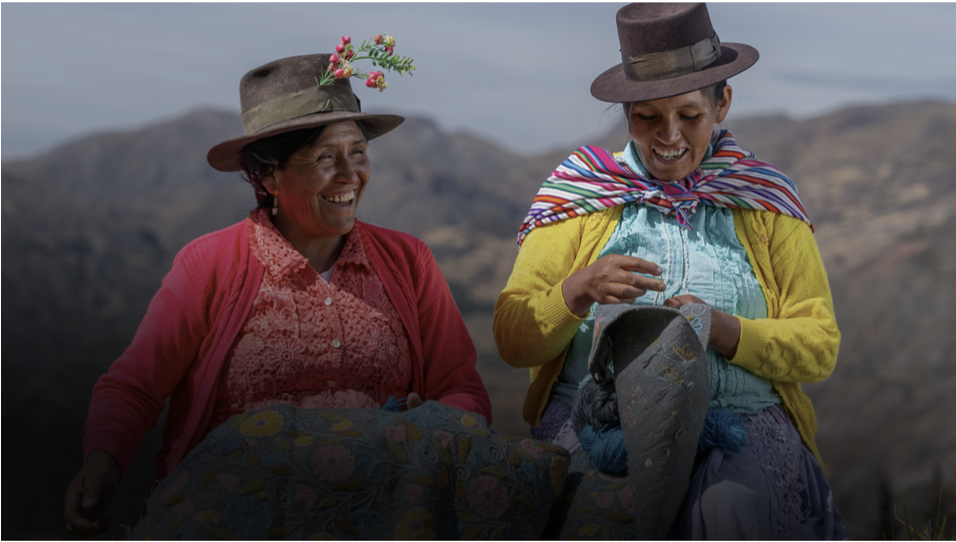
UMA Peru is a for-profit social enterprise founded in 2020 to help women artisans in rural Peru earn more from their craft and build greater economic independence. It works with more than 400 women across regions including Ayacucho and Cajamarca, connecting traditional crafts such as retablos, Huamanga stone carving and textiles with buyers willing to pay more for the skill and cultural value behind them.
My thesis used UMA as a case to examine how a social enterprise can turn market participation into meaningful empowerment, and where that translation remains incomplete. The question was not simply whether women earned more. It was whether access to income and buyers expanded their ability to make decisions about their work, their money and their lives.
That distinction matters in markets where the barriers to earning are rarely economic alone. Women may have the craft skills and an opportunity to sell, yet still lack money for materials, time away from care work, reliable transport or internet access, or support within their household. In one case documented by UMA, an artisan in Ayacucho knitted secretly at night because her husband had forbidden her to work and she risked violence if he found out. Market access has limited value if a woman cannot safely act on it.
I analysed four semi-structured interviews with UMA team members alongside eleven organisational documents, prior artisan interviews and a 2023 questionnaire conducted with participating women. I coded the material in ATLAS.ti using the Capabilities Approach from Sen and Nussbaum, which shifts the question from what resources someone receives to what they are actually able to do with them. The analysis began with economic, decision-making and social capabilities, then expanded to capture UMA’s operating model and findings that contradicted my initial expectations.
01The limits of market access
Market access alone does not create meaningful freedom.
UMA operates in a market where traditional craft carries cultural value but little bargaining power. According to its own research, some women it encountered in Ayacucho were earning around $5 a week for full-time craft, while fewer than 5 percent of the artisans it serves reach export markets, where the same work can earn substantially more. Informality, dependence on middlemen and weak infrastructure leave many artisans disconnected from the buyers who value their work most.
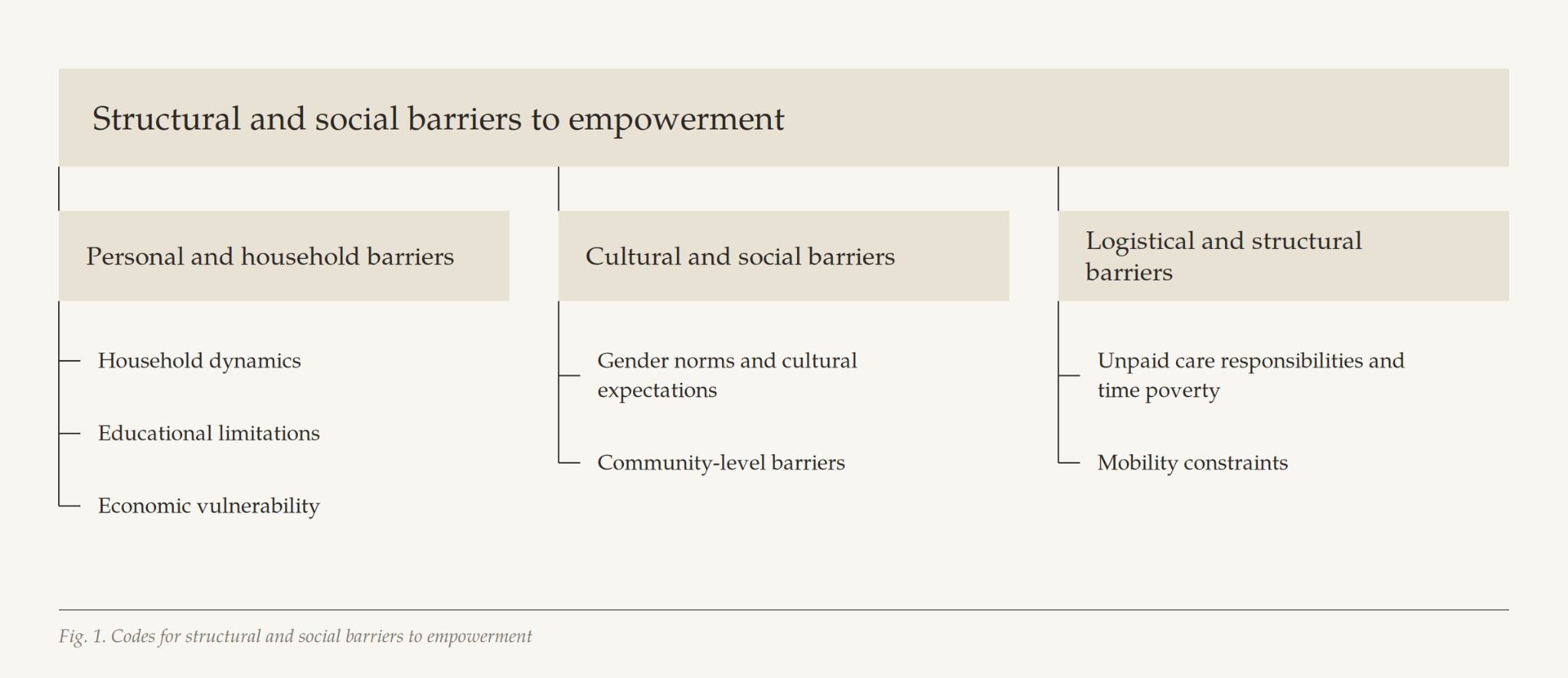
The research showed that those economic constraints sit inside a wider system. Care responsibilities determine when women can work or attend training. Some communities are several hours from the nearest town. Internet, electricity and even running water can be unreliable. Some artisans speak only Quechua. Working capital can be so limited that women cannot buy enough thread to produce a consistent order, even when demand exists. Gender norms shape which crafts women are expected to practise and whether paid work is accepted within the household.
These constraints reinforce one another. A woman may have a buyer but no capital for materials, or training but no time to attend it, or greater income but limited control over how she participates. In the language of the Capabilities Approach, these are conversion factors. They determine whether a resource can actually become a real opportunity.
That became the first important distinction in the research. Economic inclusion creates an opening for empowerment, but it does not produce empowerment by itself.
02Designing around the barriers
Operating decisions can remove practical and social barriers.
UMA’s model is interesting because several of its operating decisions respond directly to those conversion factors.
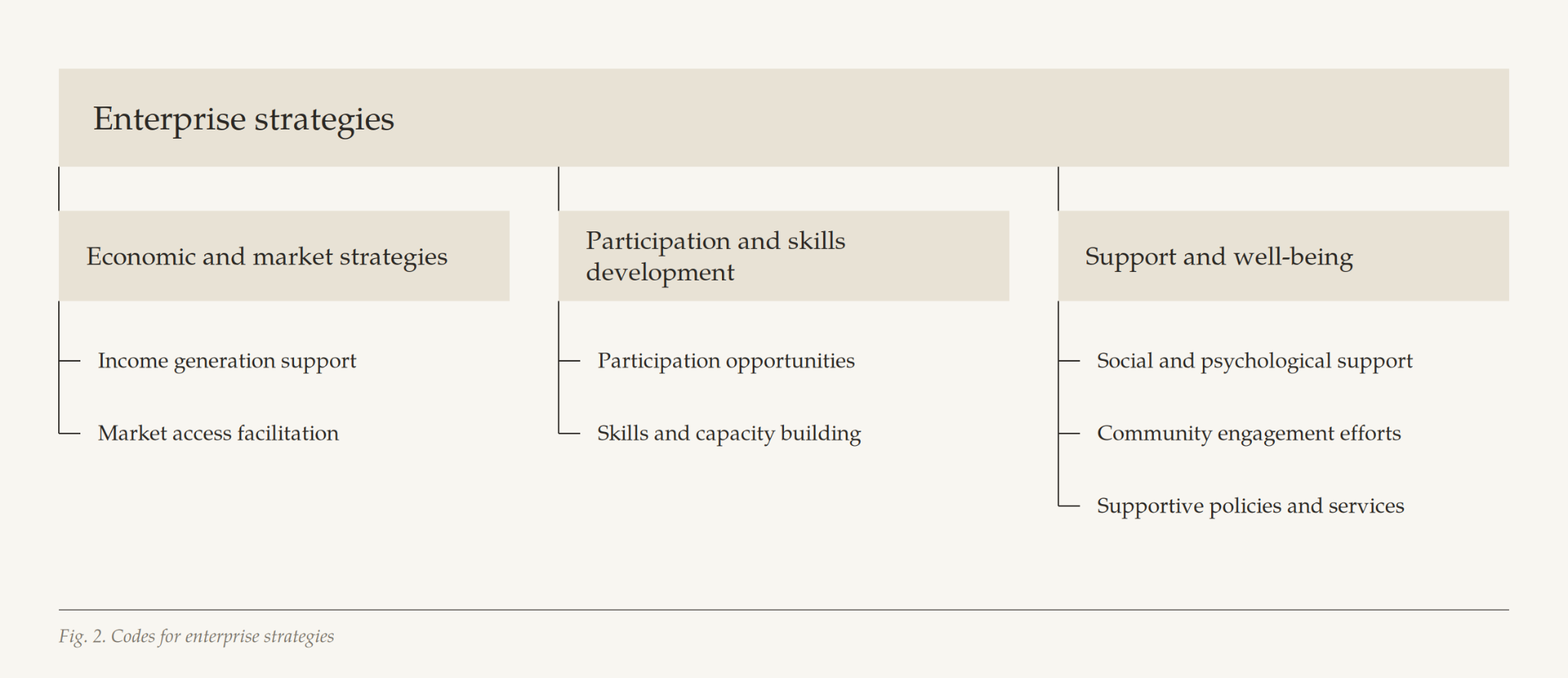
The company connects artisans with higher-paying national and international markets, but market access is only one part of the model. It advances 50 percent of an order so that women can buy materials without financing production themselves. Artisans set their own prices, which UMA says it accepts without negotiation. Product development is done through co-design, adapting formats and colours for demand while retaining the techniques, motifs and iconography of the artisans. Training and coordination are adapted to geography and digital access through phone calls, WhatsApp, visual guides and remote instruction.
The same logic appears in the way UMA works around time and care responsibilities. Field visits are scheduled around the hours women need to be home, rather than treating missed attendance as lack of commitment. In production, equipment and financing are used to remove practical bottlenecks. In communication, instructions are simplified around the infrastructure that is actually available rather than assuming reliable digital access.
Some interventions go further than accommodating an existing constraint. Huamanga stone carving had traditionally been male dominated. UMA worked with experienced male artisans to transfer the craft to women, and women later became the majority of its Huamanga stone partners. In this case, the intervention changed who could participate in the activity rather than simply helping women operate within the existing division of labour.
This is also where UMA differs from the earlier market-based models I reviewed in the BoP literature. BoP 2.0 introduced partnership and co-creation, but firms often continued to control the brand, market channel, specifications and distribution, leaving communities dependent on them. Later BoP thinking places more weight on value sharing, local ownership and changing the conditions that produce exclusion in the first place.
UMA does not resolve that power imbalance completely, but its model goes beyond giving artisans somewhere new to sell. It tries to change some of the conditions that previously prevented them from participating at all.
03From income to agency
Income gains were clearer than changes in decision-making power.
UMA’s own impact data suggests meaningful economic and relational change. It reports an average income increase of 50 percent, more than 95 percent of artisans managing their own income, 79 percent feeling more respected by their partners in household decisions and 88 percent reporting that their partners support their craft work.
Those figures need to be read carefully. They come from UMA’s own surveys, presentations and award submissions rather than independent impact measurement. One award document also reports both an average income increase of 50 percent and a move from around $20 to $120 per month, two figures that describe very different changes. I therefore treated them as UMA’s reported outcomes rather than independently established effects.
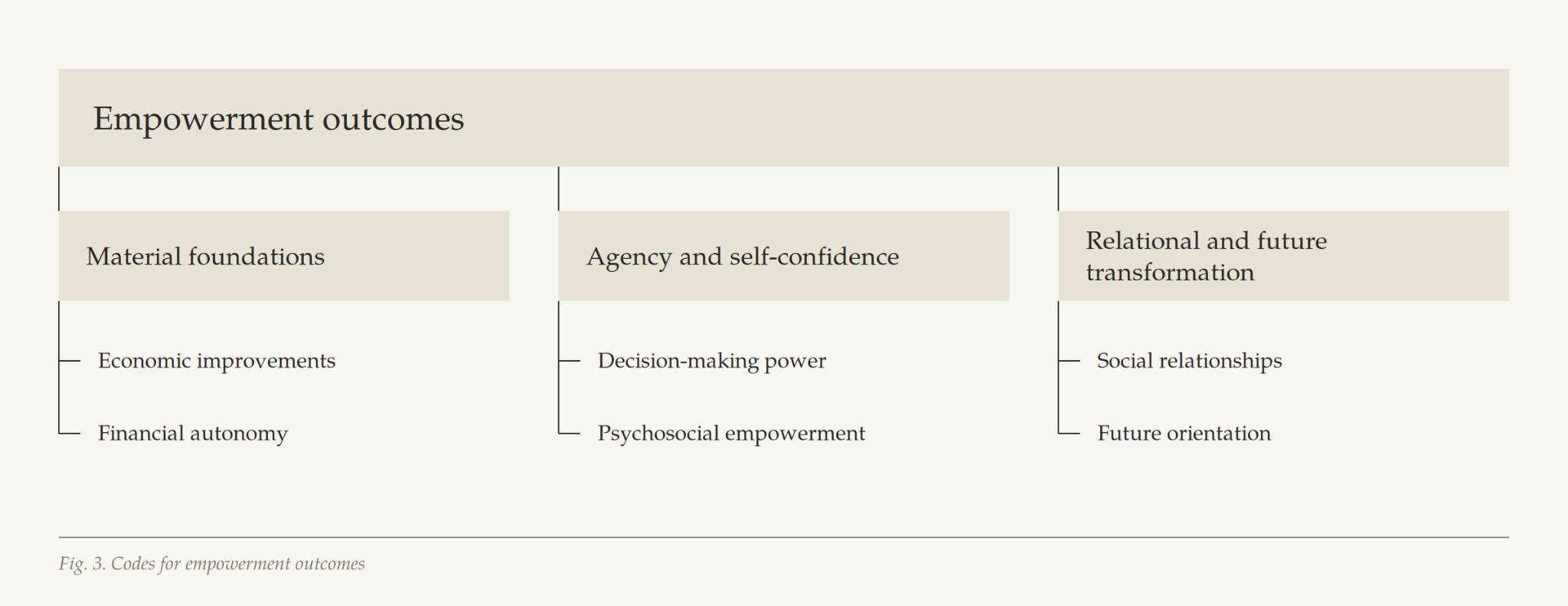
The wider dataset nevertheless showed a consistent progression. Greater income reduced some of the uncertainty around household expenses. Women were increasingly reported to manage their own earnings and make decisions about where that money went. Recognition of their work contributed to pride and greater confidence, while participation in exhibitions, storytelling, design and coordination created roles beyond production alone. Some artisans moved into local coordination or training, and younger family members began showing greater interest in crafts that had previously been associated with poverty or decline.
The coding also exposed an important imbalance in what could be evidenced. Market access appeared in 56 coded passages and income generation in 46. Decision-making power appeared in only eight. Code frequency does not measure impact, but it shows what the available material speaks about most clearly. UMA had substantial evidence of economic participation and much thinner evidence of the deeper change the thesis was trying to understand.
That made agency the harder outcome to assess. Income could be counted relatively quickly. A change in what a woman believes she can decide, negotiate or imagine for herself develops more slowly and is much harder to isolate.
- Market access56
- Income generation46
- Psychological support12
- Decision-making power8
Explore the codebook
Barriers
 View larger
Strategies
 View larger
Outcomes
 View larger
04Agency on women’s terms
Empowerment depends on women’s choices and their real options.
One finding made that problem especially clear.
UMA’s social impact team had observed that some women had health problems they were not treating. The expectation was that greater income might allow them to visit a health centre. Instead, women often directed the additional money toward their children’s education, food or improvements to the home and continued postponing their own care.
The team initially interpreted this as the income still not reaching the woman herself. Their interpretation changed when they focused on who was making the decision. If the woman controlled the money and deliberately chose to spend it on her household or her child, the outcome could still represent greater agency even if it was not the outcome UMA had anticipated.
That distinction goes to the heart of Sen’s Capabilities Approach. Empowerment cannot be judged only by whether someone reaches an externally preferred outcome. It also depends on whether she has a genuine choice and the ability to act on what she values. At the same time, Nussbaum introduces an important tension. Bodily health is itself a basic capability, so respecting choice should not make the untreated health problem disappear from the analysis.
The case therefore resists a simple definition of empowerment. Spending more on oneself is not automatically proof of greater agency, and spending on one’s family is not automatically evidence of continued dependence. The more important question is whether the woman has gained meaningful control over the decision, and what constraints still shape the options available to her.
05From supported participation to independence
Expansion needs materials, logistics and buyers alongside craft skills.
UMA itself sets a harder long-term standard. Across the interviews, team members repeatedly described the goal as reaching a point where artisans no longer need the organisation.
There are signs of movement in that direction. In Ayacucho, some artisans have progressed from relying on UMA for every logistical step to preparing and shipping products directly for Amazon orders from their communities. Women have taken on coordination and peer-training roles, and the organisation increasingly talks about transferring knowledge and responsibility rather than simply increasing order volume.
But the dependency has not disappeared. UMA still mediates access to many buyers, supports branding and compliance, coordinates parts of production and provides the relationships that connect artisans to higher-value markets. One team member acknowledged that little had yet been done to create full independence beyond discussing it with the women. The gap between participating through UMA and being able to operate without UMA remains one of the model’s unresolved questions.
Expansion makes that gap even clearer. UMA selects new regions partly on the basis that established craft skills already exist. In Cajamarca, more than 200 artisans received textile design training through a municipal partnership, yet UMA had still not been able to sell their products through its own channels. The constraint was not lack of training alone. Women could not afford enough thread to produce larger consistent orders, infrastructure was weaker and market access remained limited. A proposed thread bank intended to solve the materials problem had not secured funding.
That case changes the question of scale. Existing craft capability is not enough to determine whether the model can work in a new region. Access to materials, logistics, buyer demand, communication infrastructure and local coordination are part of the market system and need to be assessed together.
If I were translating the research into an expansion decision for UMA, I would therefore treat those conditions as entry criteria rather than problems to solve after entering a region.
06What the evidence can establish
Artisan perspectives need independent, long-term investigation.
The study can explain UMA’s model, the barriers it is designed to address and the empowerment outcomes the organisation reports. It cannot independently establish how the women themselves understand those changes.
All four primary interviews were with UMA staff. Artisan perspectives came from previous interviews and a questionnaire collected by UMA, which means their voices reached the study through the organisation. Several of the documents were also written for competitions, investors or external presentations and may naturally emphasise successful outcomes. I addressed this through triangulation, separate coding of contradictions and active attention to evidence that did not fit the dominant narrative, but those limitations remain.
The case is also specific to UMA and to the Peruvian regions in which it operates. It captures a period of change rather than following women long enough to determine whether greater confidence, decision-making power or financial autonomy endure when orders slow down or organisational support recedes.
The next study I would run would therefore begin with the artisans themselves, using a Quechua interpreter where needed, and follow the same women over time. I would want to see what happens not only when market access improves, but when it becomes less reliable, because that is where the difference between temporary participation and durable agency becomes much easier to see.